A Spice Worth a Thousand Flowers
It takes roughly 75,000 hand-picked crocus blossoms to produce a single pound of saffron. Each flower holds just three tiny crimson threads, and each thread is harvested by hand, before sunrise, so the heat of the day doesn’t dull its fragrance. No machine can do this work. No shortcut exists. Which is why saffron has been the world’s most expensive spice for thousands of years, and why a single pinch of it can turn a pot of cream the color of late afternoon sunlight.
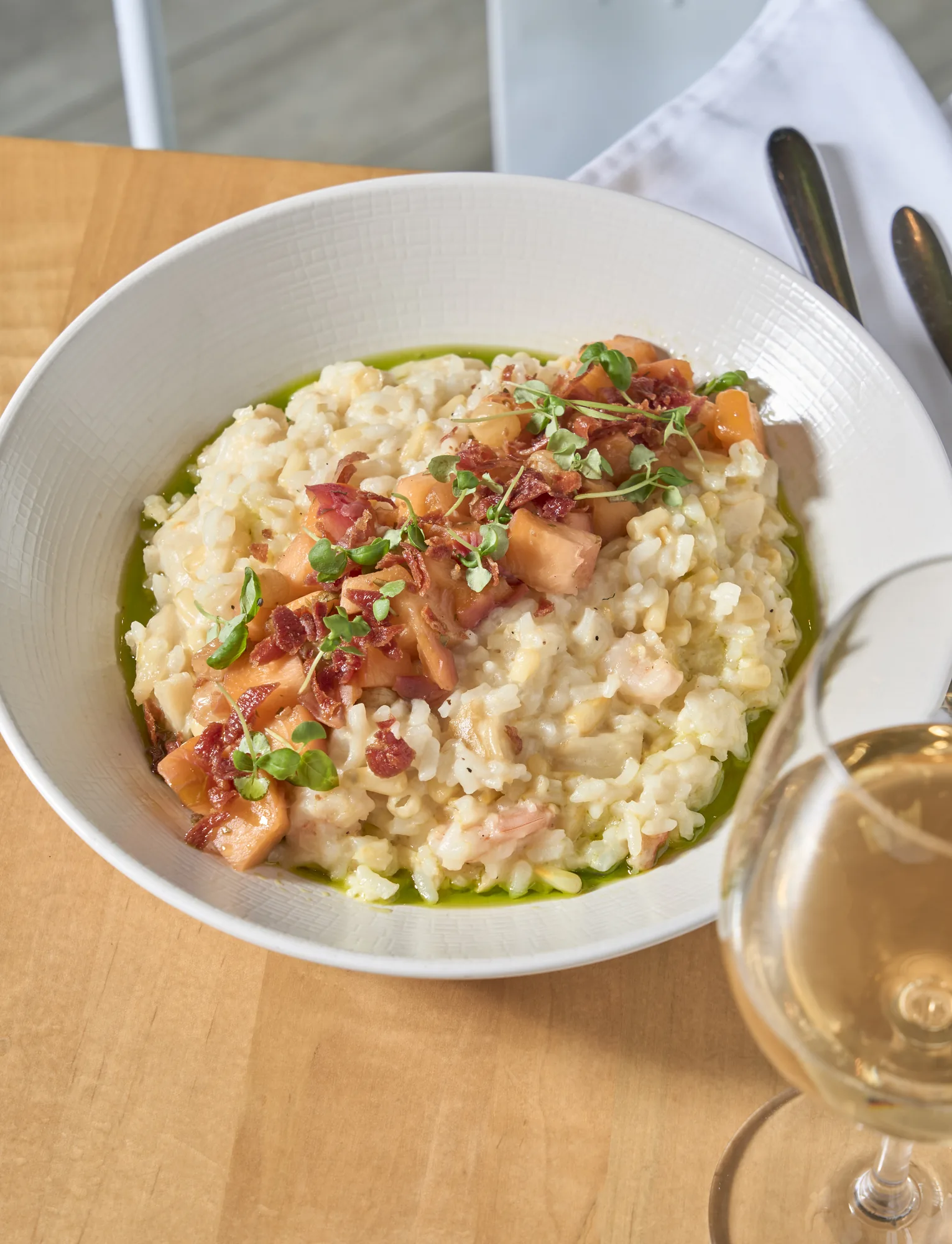
It found its way into our kitchen and straight into this risotto, and we think it was worth the wait.
From the Ancient Mediterranean to Your Plate
Saffron’s story begins in the ancient Mediterranean, where wild crocus flowers were first cultivated in Greece and Crete thousands of years ago. From there, Persian traders carried it east and west, establishing it as one of the most coveted ingredients in the ancient world. It traveled through Arab trade routes into Spain, where it became the soul of paella. It wove its way through Mediterranean kitchens across centuries, quietly becoming one of the most culturally significant ingredients in the world. Its flavor is earthy and floral at once, warm without being spicy, complex without being heavy. It doesn’t shout. It changes everything around it.
Here, it blooms into a saffron tomato cream that coats every grain of risotto with that unmistakable golden warmth.
Meanwhile, Off the Coast of New England
New Bedford, Massachusetts has been one of America’s great fishing ports since the early 1900s, and today it stands as the most valuable fishing port in the United States. The cold Atlantic waters off the New England coast produce scallops with a natural sweetness and clean ocean flavor that’s hard to replicate anywhere else. Pairing local scallops and shrimp with a spice that traveled centuries to reach the plate, that’s the kind of farm to table thinking we love. Two different journeys, one bowl.
How It All Comes Together
The risotto builds slowly, the way good risotto always does. The saffron tomato cream gives it richness and depth. Bright English peas bring a pop of color and freshness that keeps the dish feeling light. Chive oil adds an herby, grassy finish that cuts through the creaminess in just the right way. And the asiago crisp on top adds a little crunch, a little salt, a moment of texture that makes each bite more interesting than the last.
Nothing in this dish is accidental. Every element is there because it makes the others better.
A Bowl That Does Something Good
People have known about saffron’s power for a long time. Ancient healers across Persia, Greece, and the Mediterranean used it for centuries, and modern research is starting to catch up to what they already understood. Saffron is rich in antioxidants, particularly a compound called crocin, the same one responsible for that brilliant golden color. It has been studied for its role in supporting mood, reducing inflammation, and promoting overall wellbeing. All of that packed into something that also happens to taste extraordinary.
The scallops and shrimp bring serious lean protein to the bowl, clean and satisfying without heaviness. English peas add plant-based fiber and a brightness that lifts the whole dish. Chive oil carries the quiet benefits of the allium family, one of the most celebrated ingredients in whole food cooking across cultures. This is the kind of meal that earns its place on the table twice over, once for how it tastes, and once for everything it brings to the table that you can’t quite see.
Come Hungry
This is comfort food with a history behind it. A dish that rewards the curious, the hungry, and anyone who’s ever wondered what a spice worth more than gold actually tastes like. Come find out.